 (314) 222-2486



Trusted pedestrian accident lawyers with over 10 years of experience.
If you have been struck by a vehicle as a pedestrian in St. Louis, you may be suffering from severe injuries. Pedestrians struck by motor vehicles often suffer head trauma, fractures, and internal injuries because there is no protective barrier between the body and the vehicle. Documenting the location of the strike, the conduct of the driver, and the conditions at the scene is the foundation of recovery in these cases.
Schmittgens Injury Law Firm represents people injured in pedestrian crashes across St. Louis. Our founder Rob Schmittgens has handled pedestrian injury claims for ten years. Talk to a St. Louis, MO pedestrian accident lawyer clients can rely on. Schedule a free consultation today.
Pedestrian Accident Lawyer St. Louis, MO
Pedestrian cases involve two issues that do not arise in standard vehicle-on-vehicle claims. The first is the legal framework. Missouri’s traffic code includes specific provisions governing the duties of both drivers and pedestrians at crosswalks, intersections, and other crossing locations, and identifying which provisions apply is the starting point for any liability analysis.
The second is the medical picture. Pedestrians do not have any protective structure between them and a vehicle, and impact at almost any speed can produce traumatic brain injury, spinal damage, and complex orthopedic trauma that require months or years of treatment to fully document for damages purposes.
Types of Pedestrian Accident Cases We Handle in St. Louis
Pedestrian injury claims arise in many settings, and the case strategy depends on where the strike occurred, what the driver was doing, and whether any property condition or third party contributed to the incident. The case types below reflect the matters we encounter most often for clients in the St. Louis area.
- Crosswalk strikes. Pedestrians struck while crossing in marked or unmarked crosswalks at intersections are entitled to right-of-way under Missouri law when no traffic signals are operating. Liability typically rests with the driver who failed to yield.
- Intersection turn collisions. Drivers turning right or left across a pedestrian’s path at signalized intersections frequently misjudge timing or fail to check for foot traffic. Right-on-red turns are a common pattern.
- Mid-block strikes. Pedestrians struck while crossing outside a marked crosswalk are required to yield to vehicles, but drivers retain the duty to exercise the highest degree of care. Liability often turns on visibility, lighting, and the driver’s attention.
- Backing collisions in parking areas. Drivers reversing in parking lots and driveways often strike pedestrians walking behind their vehicles. Cameras and surveillance footage often determine the facts.
- Distracted driver strikes. Phone use, in-vehicle screens, and other distractions contribute to pedestrian strikes throughout the metro. Cell phone records and electronic data may support liability claims.
- DUI accidents involving pedestrians. Crashes caused by impaired drivers may support punitive damages and can be supplemented by evidence developed in the related criminal proceeding.
- Hit and run pedestrian strikes. When the at-fault driver flees the scene, the injured pedestrian’s own auto policy uninsured motorist coverage may provide recovery.
- Construction zone strikes. Pedestrians injured in or near roadway construction zones may have claims against the driver, the construction contractor, and in some cases the public entity responsible for traffic control.
- School zone and pedestrian crossing strikes. School zones carry enhanced speed limits and pedestrian protections. Violations of school zone rules can support liability claims and may aggravate damages.
- Traumatic brain injury cases. Pedestrian-versus-vehicle crashes frequently produce head trauma, spinal damage, and long-term disability. We coordinate with neurologists and life care planners to document long-term needs.
Why Choose Schmittgens Injury Law Firm for Pedestrian Cases in St. Louis, MO?
Plaintiff-Side Pedestrian Injury Experience
Founder Rob Schmittgens has spent ten years representing plaintiffs in motor vehicle and pedestrian injury matters. He earned admission to the Missouri Bar in 2016 and the Illinois Bar in 2017, with practice rights in the Eastern District of Missouri. Before founding Schmittgens Injury Law Firm, Rob handled personal injury and workers’ compensation claims at several area firms, working cases from intake through final resolution. When we serve as a client’s personal injury lawyer in St. Louis, our experience across the broader injury practice informs our approach to liability analysis, evidence preservation, and negotiation strategy in pedestrian cases.
Rob graduated with honors from Quincy University in 2013 and earned his J.D. from the UMKC School of Law. He maintains active memberships in the Missouri Association of Trial Attorneys, the Illinois Trial Lawyers Association, and the Bar Association of Metropolitan St. Louis (BAMSL).
Contingency Fee Representation
Pedestrian injury matters at our firm are handled on a contingency fee basis. We do not require retainers or hourly billing, and we advance the costs of investigation, surveillance footage requests, deposition transcripts, and court fees on behalf of our clients. Our firm has secured millions of dollars recovered for clients across the cases we have handled. If we do not produce a recovery, no fees are owed for our time.
Understanding Pedestrian Accident Cases
Damages, Liability, and Compensation for Pedestrian Accident Cases
Damages in pedestrian cases tend to run higher per case than damages in standard motor vehicle claims because the injuries are typically more severe and the recovery is often longer. Available recovery includes economic and non-economic losses, with property damage limited to personal items damaged in the strike since pedestrians are not in a vehicle.
Common categories of pedestrian accident recovery include:
- Medical expenses, including emergency care, surgery, hospitalization, and rehabilitation
- Lost wages and reduced future earning capacity
- Pain and suffering, inconvenience, and emotional distress
- Long-term care costs in cases involving permanent injury
- Loss of consortium for spouses
- Personal property damage, including phones, clothing, and other belongings
- Punitive damages where the driver’s conduct was reckless or aggravated
Liability in pedestrian cases turns on negligence, and Missouri applies pure comparative fault to allocate responsibility between the driver and the pedestrian. A pedestrian found 25 percent at fault still recovers 75 percent of established damages. Missouri imposes the highest degree of care on motor vehicle operators, particularly when children, elderly persons, or disabled pedestrians are present, and that elevated standard often shapes the liability analysis even when a pedestrian was crossing outside a marked crosswalk.
Important Aspects in Your Pedestrian Accident Case
Several practical realities affect pedestrian injury claims. Recognizing them at the outset helps preserve evidence and protect the value of the case.
- The location of the strike (crosswalk, intersection, mid-block, parking area) frames the right-of-way analysis
- Surveillance footage from nearby businesses, traffic cameras, and homes should be requested before it is overwritten
- Witness statements taken in the days following the crash are particularly important when the driver disputes liability
- Insurance adjusters for the driver’s carrier represent the carrier’s interests, not the pedestrian’s
- Pedestrians struck by drivers may have access to their own auto policy uninsured motorist coverage when the driver flees or is uninsured
- Missouri’s five-year statute of limitations governs filing deadlines for personal injury claims, including pedestrian cases
The clothing and belongings the pedestrian was wearing or carrying at the time of the strike can serve as evidence of impact location and force. Preserving these items in their post-incident condition is often useful for damages presentation.
Pedestrian Accident Case Timeline
Pedestrian injury claims generally follow a longer case timeline than typical auto cases because the injuries tend to be more severe and the medical picture takes longer to develop.
- Initial consultation, scene investigation, and surveillance footage requests
- Active medical treatment until maximum medical improvement is reached
- Records and bills collected, demand letter prepared and submitted
- Negotiation with the insurance carrier, generally 30 to 90 days
- Filing suit if negotiations stall or available limits are insufficient
- Discovery, depositions, and mediation, followed by trial or settlement
Resolution timelines vary substantially. Cases involving long-term disability, head injury, or contested causation often take more than a year to conclude, and settlement before medical treatment is fully complete frequently results in a recovery below the case’s actual value because future care needs remain undocumented.
What to Bring to Your Pedestrian Accident Consultation
The following materials, when available, allow for more efficient case evaluation at your initial consultation.
- The police or incident report, or the report number for ordering a copy
- Photographs of the scene, the vehicle, the location of the strike, and any visible injuries
- Insurance information for the at-fault driver and your own auto policy declarations page
- Medical records and bills you have received
- The clothing and belongings worn or carried at the time of the strike, if available
- The names and contact information of any witnesses
Documents not available at the time of the meeting can be requested on your behalf after we are retained. Initial consultations are at no cost and typically run for approximately one hour. You will leave with a candid assessment of the claim, including its strengths, the likely defenses, and a realistic range for the case’s value.
Missouri Legal Resources for Pedestrian Accidents
Missouri’s pedestrian framework is set out in Chapter 300 of the Revised Statutes, with additional duties imposed on drivers under Chapter 304. The resources below are commonly referenced in pedestrian injury cases.
- The pedestrian right-of-way statute requires drivers to yield to pedestrians in marked or unmarked crosswalks at intersections when traffic signals are not operating. Vehicles approaching from behind a stopped vehicle may not overtake or pass it.
- Missouri’s pedestrian yield statute requires pedestrians crossing outside a marked or unmarked crosswalk to yield the right-of-way to vehicles.
- The highest degree of care provision imposes an elevated duty on drivers to avoid striking pedestrians, with particular attention to children, elderly persons, and persons using white canes, guide dogs, or other assistive devices.
- The Missouri State Highway Patrol maintains crash records used in pedestrian cases occurring on state roads, highways, and interstates.
- National pedestrian crash data published by the NHTSA tracks fatality and injury trends across the United States.
These resources reflect general rules and available data. The value of any individual case depends on the specific facts of the strike, the medical evidence, and the carrier involved.
Reach Out to Schmittgens Injury Law Firm to Schedule a Consultation
If you have been struck by a vehicle as a pedestrian in St. Louis, contact Schmittgens Injury Law Firm before providing a recorded statement to the at-fault driver’s carrier. We will examine the police report, review available surveillance footage, and provide an honest assessment of whether you have a case worth pursuing. Initial consultations are provided at no cost, and our representation is on a contingency basis.
Pedestrian Accident Statistics in St. Louis, MO
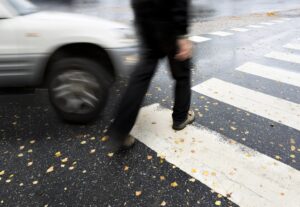 A person on foot has nothing between them and a vehicle, so even a low-speed strike can cause serious injury. Pedestrian deaths have stayed near historic highs nationally. The National Highway Traffic Safety Administration recorded 7,314 pedestrians killed in traffic crashes in 2023 and an estimated 68,244 injured, which works out to one pedestrian killed every 72 minutes.
Several patterns hold steady year to year. The same federal data show that 84 percent of pedestrian deaths happened in urban areas, 74 percent occurred away from intersections, and alcohol on the part of the driver or the pedestrian was involved in 46 percent of fatal crashes. In St. Louis, MO, where foot traffic concentrates downtown and along busy arterials, most pedestrian injuries follow the same pattern: an urban street, a driver who did not yield, and a person with no protection from the impact.
Common Causes of Pedestrian Accidents in St. Louis
Most pedestrian injuries come from a driver failing to do something the law requires. Identifying that failure is how negligence gets established and how responsibility is assigned. The causes below appear most often in St. Louis pedestrian cases.
- Failure to yield at crossings. A driver who does not yield to a person in a crosswalk is behind many of these crashes. Turning drivers watching for a gap in traffic often miss a pedestrian stepping off the curb directly in front of them.
- Distracted driving. A driver looking at a phone or a screen can travel a long distance without watching the road. At the speeds common on city streets, that lapse is enough to strike someone crossing ahead.
- Driving too fast for the area. Speed shortens the time a driver has to react and increases the force of any impact. On streets with pedestrians nearby, a few miles per hour can be the difference between a near miss and a hospital stay.
- Poor visibility after dark. Most pedestrian deaths happen at night. Drivers who outrun their headlights or fail to watch for people on foot in low light are a frequent cause, and the evidence of lighting conditions often matters to the claim.
- Impaired driving. Alcohol and drugs slow a driver’s reactions and judgment, and a large share of fatal pedestrian crashes involve impairment. These cases sometimes support more than ordinary damages once the criminal facts come out.
- Backing and turning without looking. Drivers reversing or turning across a walkway frequently strike pedestrians they never saw. These crashes happen near driveways, garages, and intersections where paths cross.
St. Louis Pedestrian Accident Lawyer FAQs
I was hit while walking. Who pays for my injuries?
Usually the at-fault driver’s auto liability insurance, the same coverage that responds in a car accident claim. As a pedestrian you were not in a vehicle, but the driver who hit you is still responsible, and their policy is generally the first source of recovery.
What if I was crossing outside a crosswalk?
You may still have a claim. Missouri drivers owe a high degree of care to avoid hitting pedestrians even outside a crosswalk, so a driver who was speeding, distracted, or not paying attention can still be responsible. Where you crossed affects the analysis but does not automatically end the claim.
What if the driver says I stepped out in front of them?
That is a common defense, and it is where Missouri’s comparative fault rule matters. Being found partly responsible reduces your recovery by your share rather than barring it. Witness accounts, camera footage, and the physical scene are what answer that argument.
What if the driver fled the scene?
A pedestrian struck by a driver who leaves is often covered by their own uninsured motorist policy, the same way any other hit and run is handled. Note any detail about the vehicle, and look for nearby cameras that may have recorded it.
How long do I have to file a claim?
Missouri allows most injury claims five years from the date of the crash under section 516.120. The video and witness evidence that prove these cases disappear far sooner, so it is better to start well before that deadline runs.
What injuries are common in pedestrian crashes?
Because nothing shields a person on foot, the injuries tend to be severe: fractures, internal injuries, spinal damage, and brain injuries. These often require extended treatment, and some effects of a head injury do not fully show up until later.
How do I prove the driver was at fault?
Through the police report, statements from anyone who saw the crash, and any video from traffic, business, or doorbell cameras near the scene. That footage is usually overwritten within weeks, so requesting it early often decides how strong the case is.
Should I give the driver’s insurer a statement?
You can report the crash, but be careful about a recorded statement to the driver’s insurer. Adjusters often call early, while you are still being treated, and an offhand answer can be used to argue you were at fault or that your injuries are minor. You can wait and speak with a lawyer first.
Does it matter that I was a child, older, or using a mobility device?
It can. Missouri law expects drivers to take extra care around children, older pedestrians, and people using canes, guide dogs, or wheelchairs. A driver who hits someone in one of those groups may face a stronger liability picture depending on the circumstances.
Will my pedestrian case go to trial?
Most resolve through settlement once treatment stabilizes and the injuries are documented. A case is more likely to head toward court when the driver’s insurer disputes fault or undervalues a severe injury, and even many of those settle before reaching a jury.
What is my pedestrian accident case worth?
It depends on the severity of the injuries, the care still ahead, lost income, and the insurance available. Pedestrian injuries are often serious, which raises the stakes, but a reliable figure has to wait until the medical records are complete.
What does a pedestrian accident lawyer cost?
The first consultation is free, and these cases run on a contingency fee. The fee comes out of any recovery, and there is no fee if there is no recovery, so you can pursue the claim while focusing on your treatment.
Local Information for St. Louis Pedestrian Accident Cases
Pedestrian crashes in St. Louis cluster downtown, near transit stops, and along wide arterial streets where people cross between blocks. After a crash, a police report, medical care, and any nearby camera footage tend to matter most, and the contacts below come up often.
Important Local Resources for St. Louis Pedestrian Accident Cases
A pedestrian struck by a vehicle will typically require a police report and medical care. Resources for each appear below, provided for reference only and without any endorsement.
- St. Louis Metropolitan Police Department, to report a crash: (314) 231-1212
- Missouri State Highway Patrol, crash report requests: (573) 526-6113
- City of St. Louis Citizens’ Service Bureau, to report a crossing or signal hazard: (314) 622-4800
- Barnes-Jewish Hospital, regional trauma care: (314) 747-3000
About Schmittgens Injury Law Firm
Schmittgens Injury Law Firm represents injured people across St. Louis, including pedestrians struck by drivers who failed to yield or pay attention. Rob Schmittgens founded the firm so that the injured client works directly with the lawyer on the claim rather than through support staff. In pedestrian cases, where injuries are often serious and fault is disputed, that means one attorney handling the evidence and the carrier from the start.
What Our Clients Say
★★★★★
“After I was hit by a car crossing the street, I was overwhelmed with medical bills and unsure what to do. Rob took the time to explain everything, dealt with the insurance company directly, and never made me feel rushed. He fought for a result that covered what I had been through, and I am grateful I called him.” — Deidre Cordia
Read more reviews on our Google Business Profile.
Contact Schmittgens Injury Law Firm
Being hit while on foot tends to mean serious injuries and an insurer already working to limit what it pays. Rob Schmittgens steps in on the other side of that. He gathers the footage and witness accounts before they disappear, deals with the driver’s carrier directly, and keeps you focused on healing rather than fighting an adjuster. The first conversation is free, and the firm earns a fee only from a recovery. Contact us to talk to a St. Louis pedestrian accident lawyer about your options.